


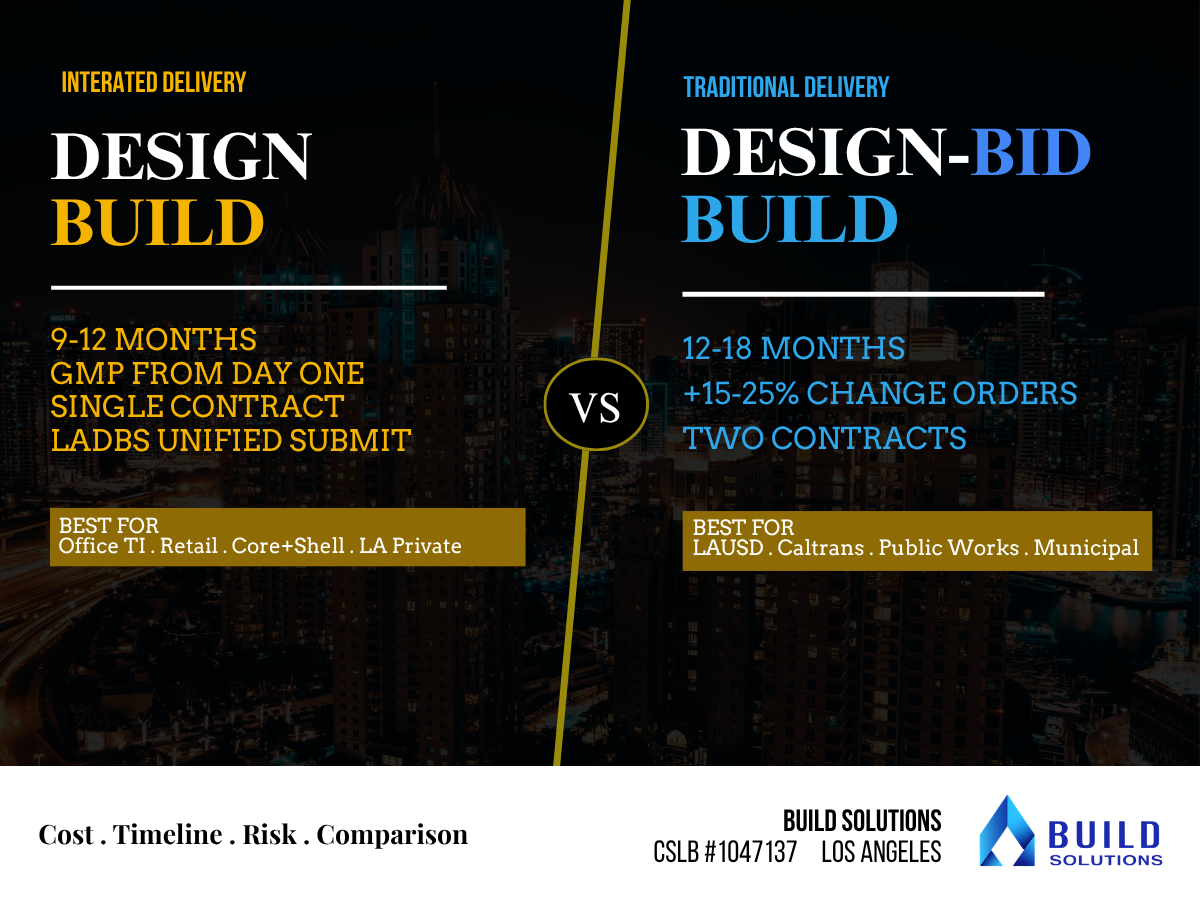
Los Angeles commercial construction in 2026 operates under real pressure. LADBS plan checks currently run 8 to 12 weeks. Seismic code requirements add costs that only surface during construction. And with the 2026 FIFA World Cup accelerating development across the region, trade availability is tighter than it has been in years. In this market, the delivery method you choose is not a formality. It is a financial decision that shapes the outcome of your entire project.
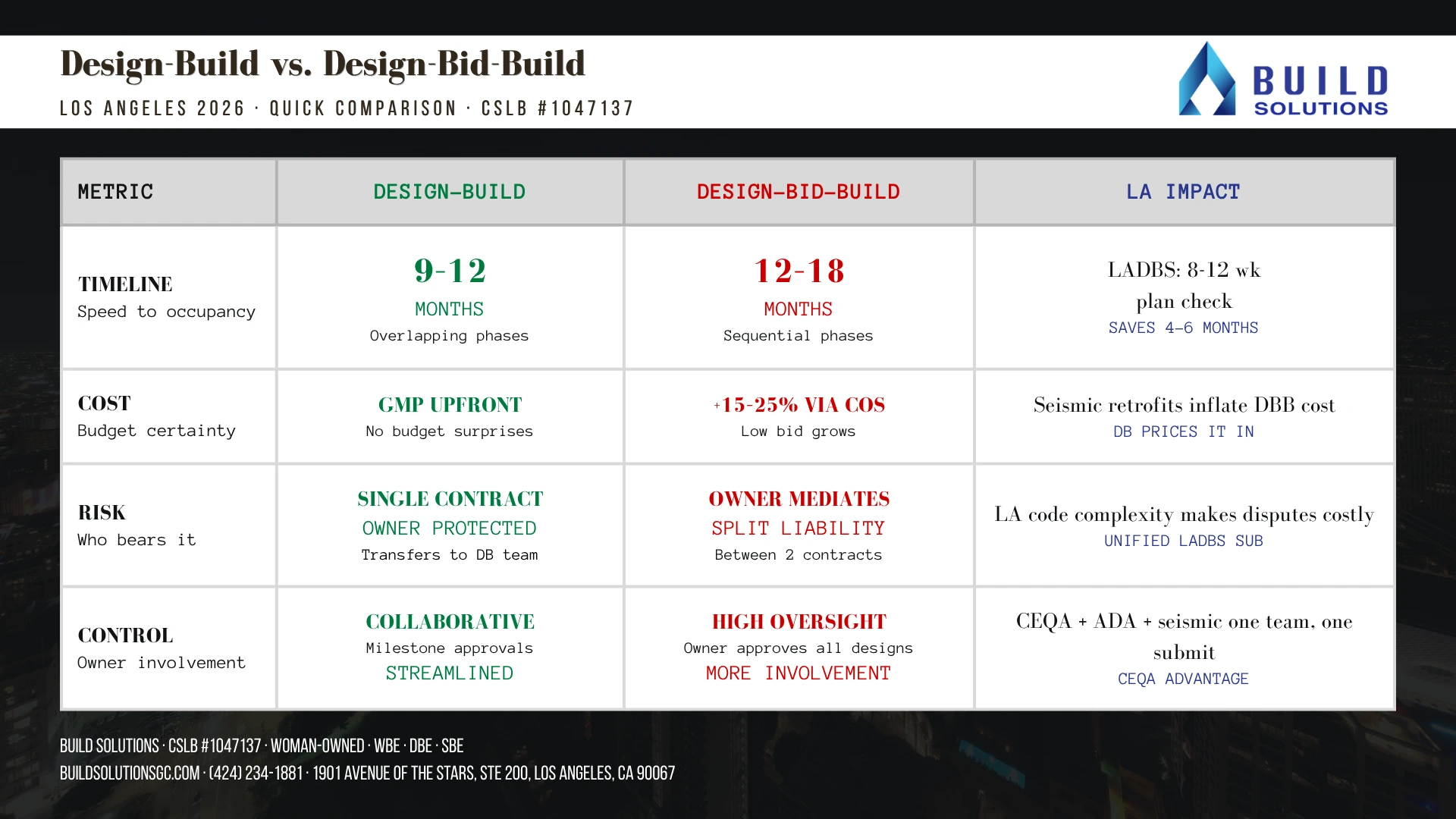
Quick Comparison: Design-Build vs. Design-Bid-Build in Los Angeles
Why Los Angeles Favors Design-Build in 2026
The LADBS permitting process is where the delivery-method gap is most visible in Los Angeles.
Under design-bid-build, the sequence is linear. The architect completes the design, submits it to LADBS, receives comments, and then must coordinate corrections with the separately hired contractor before resubmitting. When those corrections involve structural or MEP systems, that back-and-forth between two independent teams adds weeks to an already long plan check cycle.
Design-build eliminates that hand-off. One team prepares the LADBS submission package, coordinating architectural, structural, mechanical, electrical, and plumbing from the start. Seismic compliance, CEQA documentation, and fire-life safety requirements are resolved during design, not flagged as post-submission corrections. When LADBS comments come back, the same integrated team responds without routing changes through two separate contracts.
On a typical LA commercial tenant improvement or core-and-shell project, this difference saves four to six months of total project duration compared to a sequential design-bid-build path.
With FIFA World Cup construction activity driving up subcontractor demand across Los Angeles through 2026, every week saved on delivery has real dollar value for owners managing carrying costs and lease obligations.
For a full walkthrough of how the design-build process moves through LA permitting from pre-construction through occupancy, read our complete guide to design-build in Los Angeles.
Cost Breakdown: Where the Numbers Actually Differ
Design-Build: Guaranteed Maximum Price
The GMP structure is what makes design-build cost certainty real. Because the contractor is part of the project team from the first design session, cost modeling happens alongside every design decision. You know what your project costs before construction documents are finalized, not after you have spent months completing them.
In Los Angeles specifically, this matters because of seismic requirements. California Title 24 and LADBS seismic standards frequently require structural upgrades that are not visible until construction begins. A design-build team surfaces and prices these during the design phase. A design-bid-build contractor discovers them during demolition and submits a change order.
Design-Bid-Build: The Low Bid That Grows
Competitive bidding looks like cost control. Contractors bid only on what is explicitly written in the documents. Any ambiguity, any unforeseen condition, any gap between what the architect specified and what the market actually supplies becomes a change order. Industry data reveal that DBB projects average 8 to 12% in change-order growth above the original bid. In Los Angeles, where seismic retrofits, hazardous material abatement, and ADA corrections are common in existing commercial stock, that figure climbs further.
The low bid is the starting price. The final invoice often tells a different story. To understand this fully, see how tenant improvement projects in Los Angeles are priced and planned differently under each delivery model.
Build Solutions Performance: What the Numbers Show
Build Solutions (CSLB #1047137) recent project for an aerospace sector tenant improvement in Los Angeles.
Build Solutions is a women-owned firm, certified WBE, WBENC, DBE, and SBE, holding CSLB License #1047137. Founded by Natalia Piper, a licensed GC with a Master's degree in Mechanical Engineering and a UCLA Project Management Certificate, the firm has over 25 years of commercial construction experience in Los Angeles. Active project types include tenant improvements, core and shell, retail, office, health clinics, and work in the aerospace and aviation sectors.
You can review completed projects across these categories on the Build Solutions project portfolio.
For a breakdown of what separates a true design-build firm from a traditional GC that calls itself one, read our guide to choosing the right design-build firm in Los Angeles before signing any contract.
LA Permitting: How Each Method Handles It
Design-Build Submission Process
A unified team prepares one coordinated LADBS package. Seismic calculations, CEQA review documentation, ADA compliance, and fire-life safety are integrated by the same team that is building the project. Corrections come back to one point of contact who can respond without coordinating between two separate firms.
For owners navigating LADBS Ordinance 183893 seismic retrofit requirements, design-build is especially effective. The structural engineering decisions are made alongside the design, not after bids are received.
Design-Bid-Build Submission Process
The architect submits independently. If LADBS requires structural revisions, the owner must coordinate between the architect and the contractor to determine who is responsible and who is paying. This is standard procedure in design-bid-build, and it is a normal source of delay that has nothing to do with incompetence on either side. It is simply what happens when two contracts govern one project.
For publicly funded projects under LAUSD, Caltrans, or municipal jurisdiction, this process is legally mandated and the appropriate choice.
When LA Businesses Choose Each Method
Design-Build Works Best For:
Private commercial projects where timeline, cost certainty, and integrated delivery matter. Office tenant improvements where the lease clock is already running. Retail and restaurant buildouts where health department and fire marshal approvals require tight coordination between design and construction decisions. Core and shell construction, where structural, MEP, and architectural decisions have immediate cost implications. Adaptive reuse projects where construction discoveries can change design direction, and a split-team model cannot respond quickly enough.
Read more about how tenant improvements in Los Angeles benefit specifically from a design-build delivery. For new construction from the ground up, our guide to ground-up construction in Los Angeles covers how design-build compresses the full development timeline.
Design-Bid-Build Is the Right Choice For:
Publicly funded work where competitive procurement is legally required, such as LAUSD school construction, Caltrans, and municipal contracts. Projects where the scope is fully defined, design changes during construction are unlikely, and the owner has the internal capacity and interest to manage two separate contracts through the full project lifecycle.
Frequently Asked Questions
What is the main difference between design-build and design-bid-build in Los Angeles?
Design-build uses a single contract with one integrated team managing both design and construction. Design-bid-build uses two separate contracts, one with an architect and one with a contractor, and follows a sequential process where design must be complete before construction begins. In Los Angeles, the key practical difference is permitting speed: design-build can submit a unified LADBS package and begin construction. At the same time, design is still being refined, while design-bid-build requires each phase to finish before the next can start.
Is design-build more expensive than design-bid-build?
Not in the total project cost. Design-build sets a Guaranteed Maximum Price during early design, which means the final invoice is typically very close to the initial estimate. Design-bid-build starts with a lower-looking bid, but change orders on LA commercial projects average 8 to 12% of contract value above the original bid, and seismic, CEQA, and ADA variables push that figure higher in this market.
How long does LADBS permitting take for a commercial project in Los Angeles?
LADBS plan check timelines for commercial projects currently run 8 to 12 weeks, depending on project type and office location. Design-build reduces total permit-to-occupancy time by overlapping design development with permitting preparation. Design-bid-build adds the bidding period (typically 4 to 8 weeks) to the sequential permitting timeline.
Which delivery method is better for a tenant improvement in Los Angeles?
For most private commercial tenant improvements, design-build is the stronger choice. Lease clocks start on signing day. Every week the space is not ready, revenue is lost. The overlapping phases and single-team accountability of design-build consistently deliver TI projects faster and with fewer budget surprises than design-bid-build.
How do I verify a design-build contractor's license in Los Angeles?
Search the California State License Board database using the contractor's name or license number before signing anything. Build Solutions' CSLB license number is #1047137.
Get a Free LA Permitting Timeline Analysis
Build Solutions is currently delivering design-build projects across Los Angeles, including commercial tenant improvements, core-and-shell construction, and aerospace sector work.
Contact the team at buildsolutionsgc.com or call (424) 234-1881 to discuss your project scope, your realistic LADBS permitting window, and whether a Guaranteed Maximum Price structure is the right fit.
Related News


.svg)