



Most commercial landlords in Los Angeles offer a tenant improvement allowance ranging from $25 to $150 per square foot, depending on property type, lease term, tenant creditworthiness, and current market conditions. However, many business owners discover that these allowances cover only a fraction of actual construction costs once they are on-site and building.
Understanding how the TI allowance works before you sign a lease can help you negotiate better terms, avoid costly budget overruns, and dramatically reduce out-of-pocket expenses. This guide breaks down what landlords are currently offering in LA, what build-outs actually cost in 2026, and how to close the gap between the two.
What Is a Tenant Improvement Allowance?
A tenant improvement allowance (also called a TIA, TI allowance, or tenant build-out allowance) is a pre-negotiated sum of money a landlord contributes toward customizing a leased commercial space. It is almost always expressed as a dollar amount per rentable square foot. If you lease 3,000 SF and the landlord offers $60/SF, you have $180,000 toward your build-out. That sounds like a lot until you see what construction actually costs in Los Angeles.
Landlords offer TI allowances because they make their properties more competitive, attract quality long-term tenants, and justify higher base rent over the lease term. It is an investment, not a gift. Build Solutions provides tenant improvement construction services across Los Angeles, from office fit-outs to medical facilities and retail build-outs.
Cash allowance vs. turnkey build-out: With a cash allowance, you manage the build-out and the landlord reimburses you against invoices up to the agreed cap. With turnkey, the landlord delivers a finished space but typically uses the most cost-effective materials. For most tenants, the cash allowance gives you better control over quality and budget.
Typical Tenant Improvement Allowances in Los Angeles (2026)
The following ranges reflect current market conditions across Greater LA. Allowances at the higher end typically require 7 to 10-year lease terms and strong tenant credit profiles.
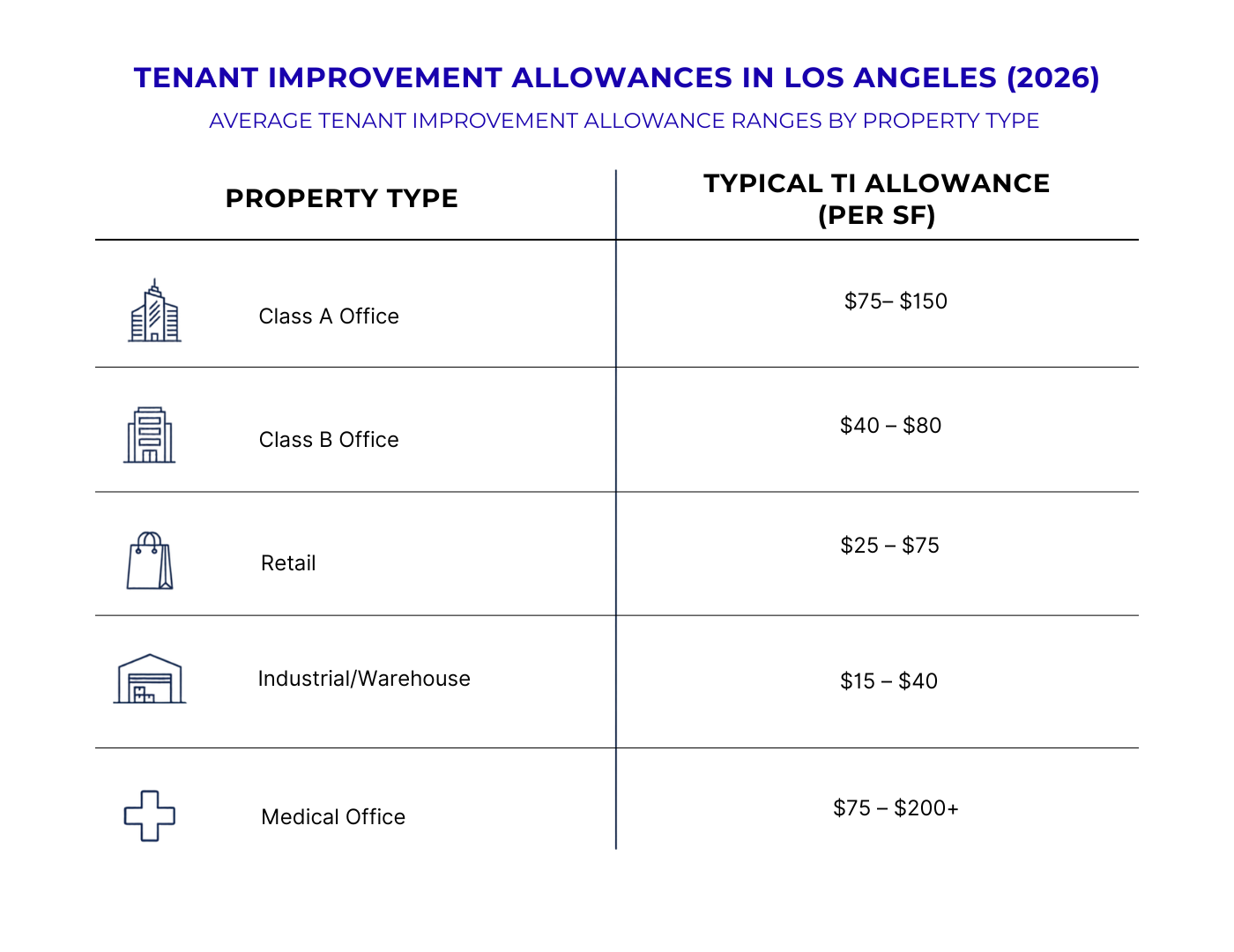
Medical tenants command the highest allowances because landlords recognize they renew for decades. Industrial spaces receive the lowest because build-outs are relatively simple.
What Factors Affect Your Tenant Improvement Allowance?
- Lease length is the single biggest lever. A 10-year lease can justify nearly double the allowance of a 5-year lease, since landlords amortize the cost over the term.
- Market vacancy rates matter too. In 2026, elevated office vacancy across much of LA continues to give tenants meaningful leverage, particularly in West LA, the San Fernando Valley, and parts of Downtown.
- Tenant credit profile rounds out the top three. A business with audited financials and strong cash flow will consistently receive better offers than a startup. Building class, space condition, and location within LA also influence the final number.
Tenant Improvement Allowance vs. Actual Build-Out Costs
This is where business owners get into financial trouble. The gap between what a landlord offers and what construction actually costs in Los Angeles is substantial, and it is almost always the tenant's responsibility to fund the difference.
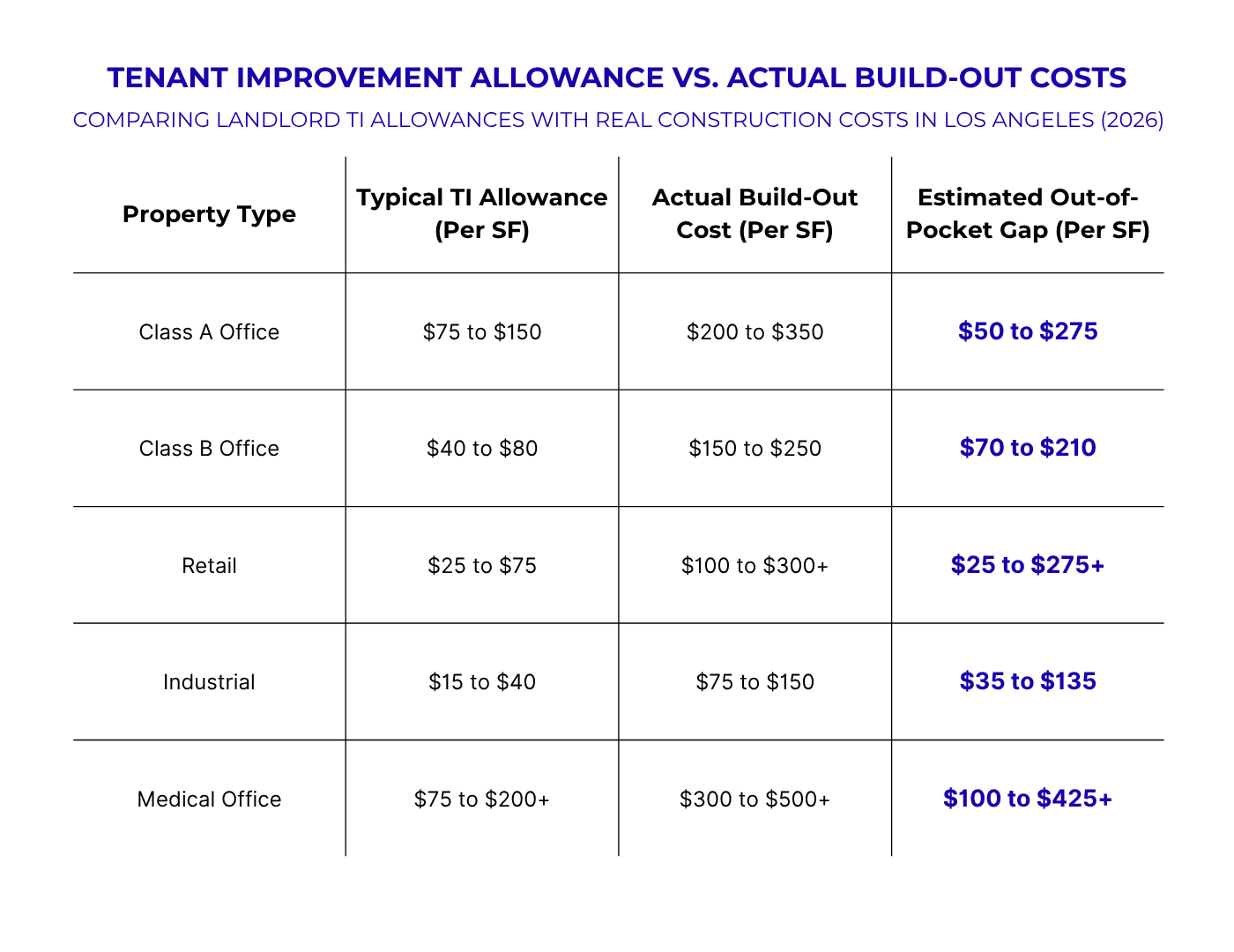
On a 3,000 SF Class B office with a mid-range build-out, a tenant could easily face $200,000 or more in out-of-pocket costs that the landlord's allowance does not cover.
One critical line item most tenants miss: soft costs. In Los Angeles, architecture, engineering, LADBS plan check fees, and the Affordable Housing Linkage Fee (which can add $3 to $5+ per SF depending on location) consume 20 to 30 percent of your total budget on top of hard construction costs. For a full breakdown by space type, see our guides on Tenant Improvement in Los Angeles and the Tenant Improvement Guide Los Angeles.
- Office build-out costs run $150 to $350/SF, depending on spec. See our Office Build-Out Cost Per Square Foot Los Angeles 2026 guide for a detailed submarket breakdown.
- Retail and restaurant build-outs range from $100 to $450+/SF, depending on use. Full commercial kitchen builds are at the high end. Before signing a restaurant lease, read our Restaurant Tenant Improvement in Los Angeles guide.
- Medical office build-outs routinely reach $300 to $500+/SF due to OSHPD requirements, specialized plumbing, and HVAC filtration. See our Medical Office Construction in Los Angeles guide before you start.
How to Negotiate a Better Tenant Improvement Allowance
Get contractor pricing before lease negotiations begin. This is the step most tenants skip. If your build-out costs $180/SF and the landlord opens at $65/SF, you know your exact gap and can negotiate from a position of fact rather than guesswork.
Use lease length strategically. A landlord who hesitates at $80/SF on a 5-year deal may agree quickly on a 7-year term.
Ask for free rent in addition to the TI allowance. These are separate concessions: free rent covers early cash flow, TI covers capital expenditure. You can often get both.
Finally, nail down reimbursement terms and deadlines in writing. Most allowances have a "use it or lose it" window of 6 to 12 months. Missing it means forfeiting the funds entirely.
Common Tenant Improvement Allowance Mistakes
Signing before obtaining construction pricing is the single most common and costly mistake. Tenants commit to a lease based on the TI allowance alone, then discover mid-build that they are $150,000 short. Ignoring soft costs is a close second: architect fees, MEP engineering, and LADBS fees regularly add 20 to 30 percent to a project budget that was never accounted for. Failing to test existing building systems is the third: HVAC capacity, electrical panels, and plumbing condition should all be independently assessed before signing. Discovering incompatible systems after lease execution is an expensive, avoidable problem.
Real Example: Why a $100/SF TI Allowance May Not Be Enough
A healthcare company signs a lease on 4,000 SF of Class B office space in Culver City. The landlord offers a $100/SF TI allowance totaling $400,000.
Hard costs (partitions, flooring, lighting, HVAC, plumbing, electrical) at $200/SF: $800,000
Soft costs (architecture/MEP at $60K, LADBS permits at $25K, linkage fees at $18K, project management at $20K): $123,000
Total project cost: $923,000. Landlord contribution: $400,000. Out-of-pocket gap: $523,000.
A $100/SF allowance covered less than half a moderate build-out. This is the norm in Los Angeles, not the exception. To see how Build Solutions has managed TI projects across office, medical, and commercial spaces throughout LA, browse our completed projects.
Tenant Improvement Timeline in Los Angeles
- Design and engineering (4 to 8 weeks): Stamped MEP drawings are required before LADBS will accept a permit application. No architect means no permit.
- Permitting through LADBS (4 to 6 months): Plan checks typically require 2 to 3 correction rounds. This is the most common source of delay. For a step-by-step guide to the process and fees, read our LADBS Tenant Improvement Permit Guide: Los Angeles 2026.
- Construction (3 to 6 months): Scope and subcontractor availability determine the range. Inspections and close-out (2 to 4 weeks): Certificate of occupancy and punchlist items close the project.
- Realistic total timeline: 9 to 14 months from lease signing to opening. Any contractor promising a full LA build-out in 3 months should be questioned closely.
How Build Solutions Helps Businesses Maximize Their TI Budget
Pre-lease assessments give you real construction costs for a specific space before you commit to lease terms, putting you in a far stronger negotiating position. Budget forecasting accounts for hard costs, soft costs, LADBS fees, and linkage costs, so there are no mid-project surprises. Permit coordination minimizes LADBS correction cycles and keeps your schedule on track. Construction management ensures every TI dollar goes toward quality work delivered on time.
Contact Build Solutions before your next lease negotiation. The earlier we get involved, the more budget we can protect. Learn more about who we are and what we build at buildsolutionsgc.com.
Frequently Asked Questions
- What is a typical tenant improvement allowance?
In Los Angeles, a typical tenant improvement allowance ranges from $25 to $150 per square foot, depending on property type, lease term, and tenant credit profile. Class A office spaces command the highest allowances ($75 to $150/SF), while industrial properties see the lowest ($15 to $40/SF).
- How is a tenant improvement allowance calculated?
TI allowances are calculated by multiplying the per-square-foot allowance by the total rentable square footage. A $60/SF allowance on a 3,000 SF space equals a $180,000 total allowance.
- Is a tenant improvement allowance negotiable?
Yes, and often more negotiable than base rent. Lease length, tenant creditworthiness, building vacancy, and space condition all influence how much you can negotiate. Real contractor bids give you significant leverage.
- What happens if construction costs exceed the allowance?
The tenant funds the difference unless otherwise negotiated in the lease. This is why obtaining real cost estimates before signing is essential.
- Who owns tenant improvements after the lease ends?
In most commercial leases, the landlord owns the improvements once installed. Some leases include restoration clauses requiring the tenant to remove specific improvements at lease end. Review this language carefully before signing.
- Do TI allowances cover permits and design fees?
Not always. Many allowances cover hard construction costs only. Architecture, engineering, and permit fees are frequently excluded. Negotiate to include soft costs in your allowance wherever possible.
- How much do tenant improvements cost per square foot in Los Angeles?
Office spaces run $150 to $350/SF, retail ranges from $100 to $450+/SF depending on use, medical office build-outs cost $300 to $500+/SF, and industrial improvements run $75 to $150/SF. Soft costs add another 20 to 30 percent.
Related News


.svg)